
The Admit Method

For parents of high school students in grades 9-12

Stop wondering if your teen is doing enough for college.

See where your teen stands with selective colleges and the three things to fix first. One 37-page guide with a 16-question checkup and a 90-day plan. Fill it in on screen or print it.

  • A 16-question checkup you and your teen finish in about 25 minutes
  • Three clear priorities, so you stop guessing what matters
  • A 90-day plan you can start this week
  • Bonus: a one-on-one strategy call to talk through where your teen stands

$29 one-time. Instant access.

Get the guide for $29
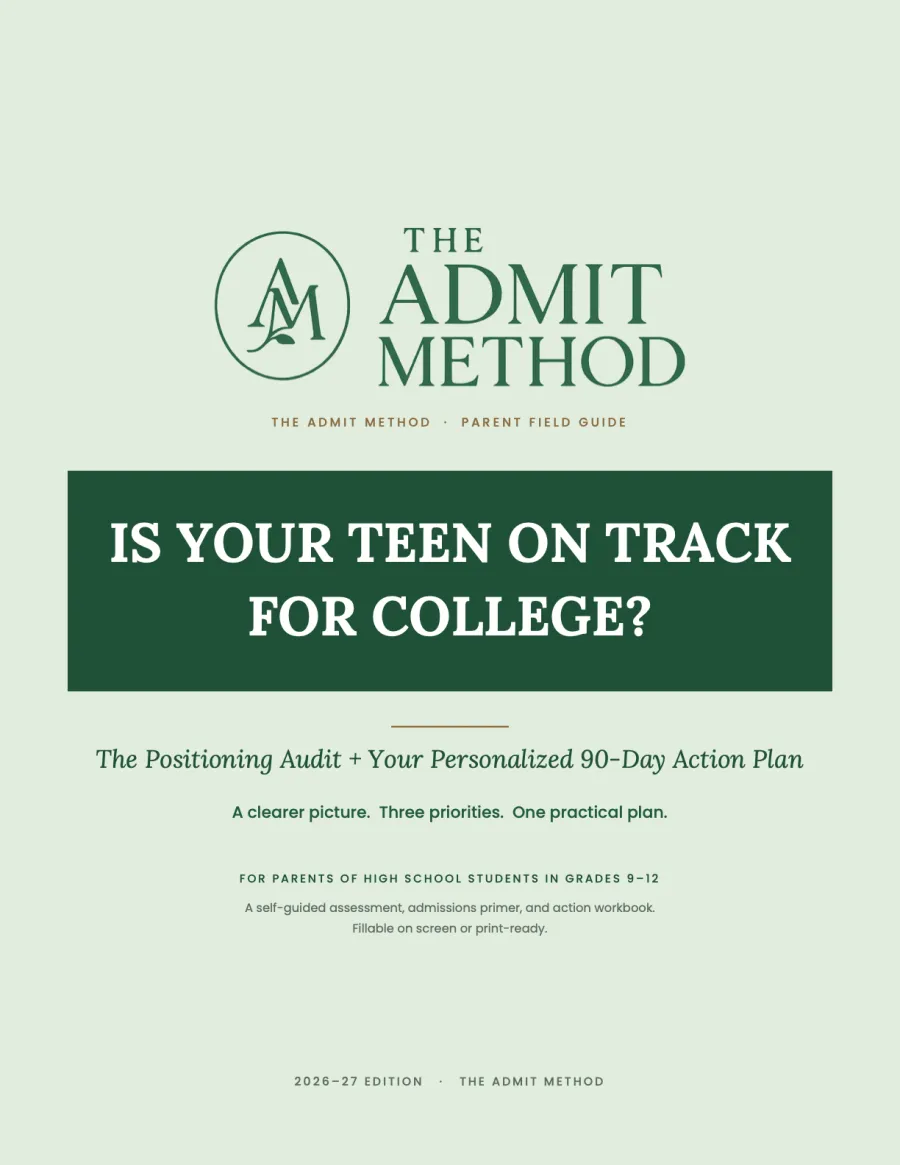
Cover and inside pages of the guide Is Your Teen On Track for College

Good grades. A full schedule. No clear answer.

Why good students get rejected

Harvard, Stanford, MIT, Yale, and Princeton have each admitted fewer than 5 percent of applicants in recent years.

Nearly everyone in those pools has excellent grades. So the question an admissions reader asks is rarely “Is this student good enough?” It is “Why this student, out of thousands who look similar on paper?”

Most families prepare for the first question. You may know the signs:

  • Your teen works hard and is busy every week, and you still cannot say what makes them stand out.
  • The advice you hear is always “more.” More clubs. More APs. A nonprofit.
  • You keep asking yourself if you are doing this right, and nobody gives you a straight answer.
  • You are the one tracking deadlines, testing rules and the college list, and reminding your teen has started to feel like nagging.
  • Another family's teen got in somewhere, and you cannot see what they did differently.
  • You are afraid of finding out in March, when decisions arrive, that something was missing.

Qualified is the baseline. Positioned is the difference.

A strong application can still be an unclear one, and an unclear application is easy to forget.

An application with twenty unrelated activities gives an admissions reader nothing to argue for. One that points in a single direction makes the case almost by itself.

The checkup below shows which kind of application your teen is building today.

How the checkup works

See where your teen stands in about 25 minutes

The guide is built on Position Engineering, the method behind The Admit Method. It never invents anything. It finds what is already true about your teen and makes it hard to miss.

The idea at the center is a spike: one clear area of depth that shows up in your teen's courses, activities and story. It can be small. It has to be real.

You and your teen score 16 statements across four areas. Inside the guide, the checkup is called the Positioning Audit.

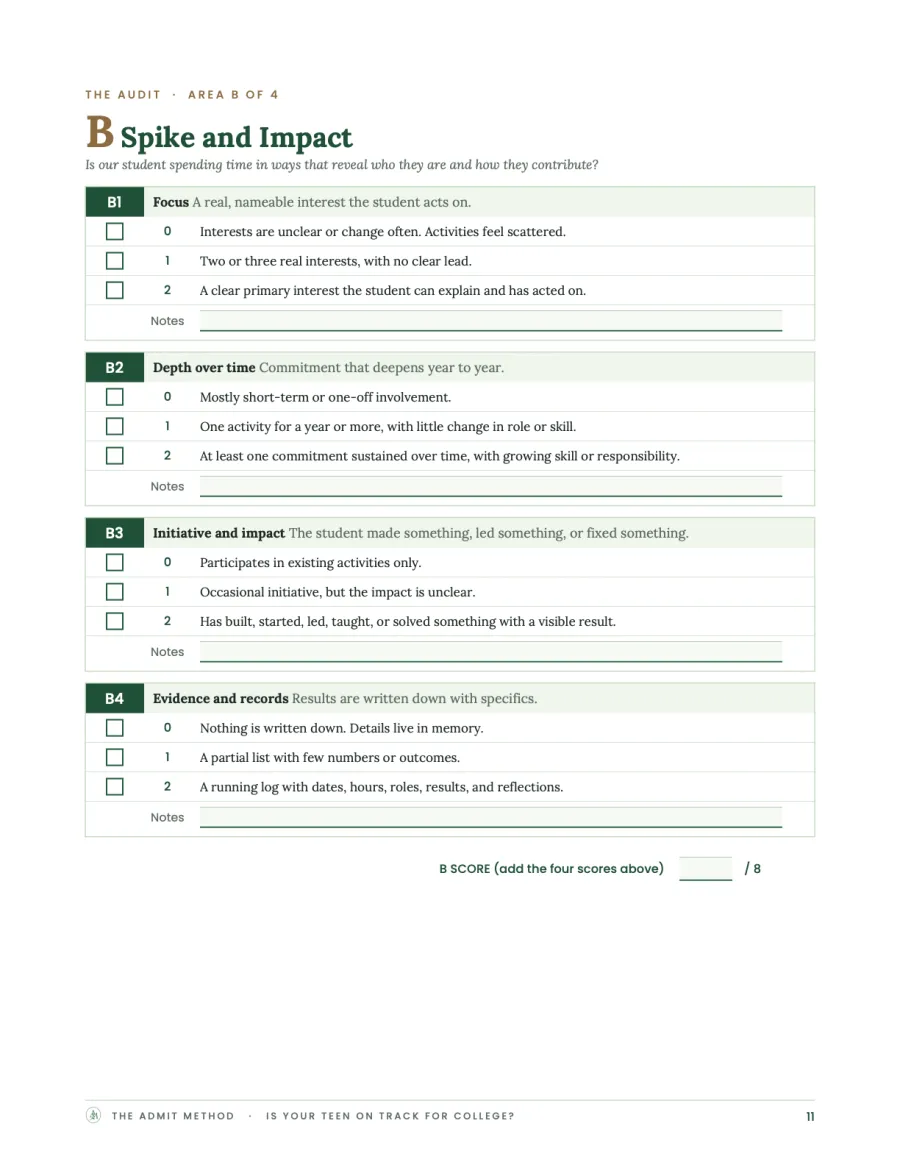
A page of the checkup showing the Spike and Impact questions and score boxes

Academic Foundation

Grades, course rigor, study systems and testing readiness.

Spike and Impact

Focus, depth over time, initiative and a written record of what your teen has done.

Story and Positioning

Whether someone could describe your teen in one specific sentence, plus recommenders and raw material for essays.

Plan, List and Affordability

Timeline, college list, cost and who owns what.

Then three steps turn the scores into a plan:

  1. Read Part One. About 15 minutes. It shows how selective colleges read an application.
  2. Take the checkup together. About 25 minutes. Your teen answers first.
  3. Choose three priorities and build your 90-day plan from the action library.

Reem has reviewed more than 200 student applications.

A common pattern: strong grades, and no clear spike or story yet. This guide is built to close that gap.

Get the guide for $29

Fill it in on screen or print the pages you need.

Three students, three positioning moves

The qualifications did not change. The positioning did.

Three students who worked with Reem in the full Admit Method program.

Ryan

Ryan had a 4.0 GPA, leadership roles, and awards. He was admitted to MIT, Stanford, and UT Austin as an engineering-focused applicant with a multi-year robotics spike.

The move: No new activities. The whole application centered on the robotics work he had been doing for his disabled brother.
Sophia

Sophia had a 3.2 GPA. She was admitted to Johns Hopkins, the University of Michigan, and Brown.

The move: Her own life story was tied to the field she wanted to study, so the application had a clear purpose.

Ava

Ava was waitlisted at Vanderbilt, her top choice. She was admitted to Vanderbilt off the waitlist.

The move: The waitlist was treated as a second application, with a tighter story and a letter of continued interest.

A note on these stories: students are shown by first name. All three worked with Reem in the full Admit Method program, which is separate from this guide. Your teen's path will be different, and this page makes no promise about what a college will decide.

The guide teaches the same thinking these three applications used, and shows you where your own teen stands on it.

Get the guide for $29

The checkup, the 90-day plan and a bonus strategy call. $29 one-time.

What is inside the guide

What you get for $29

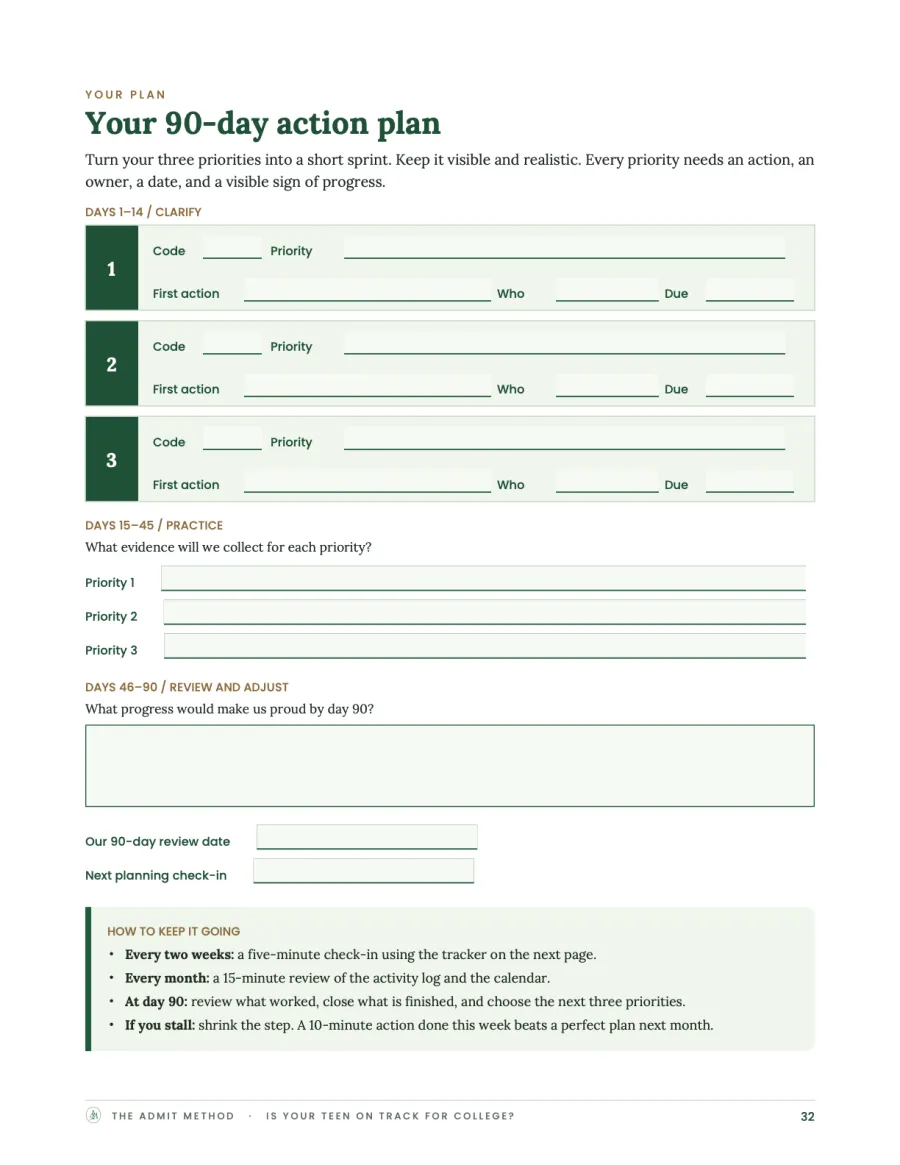
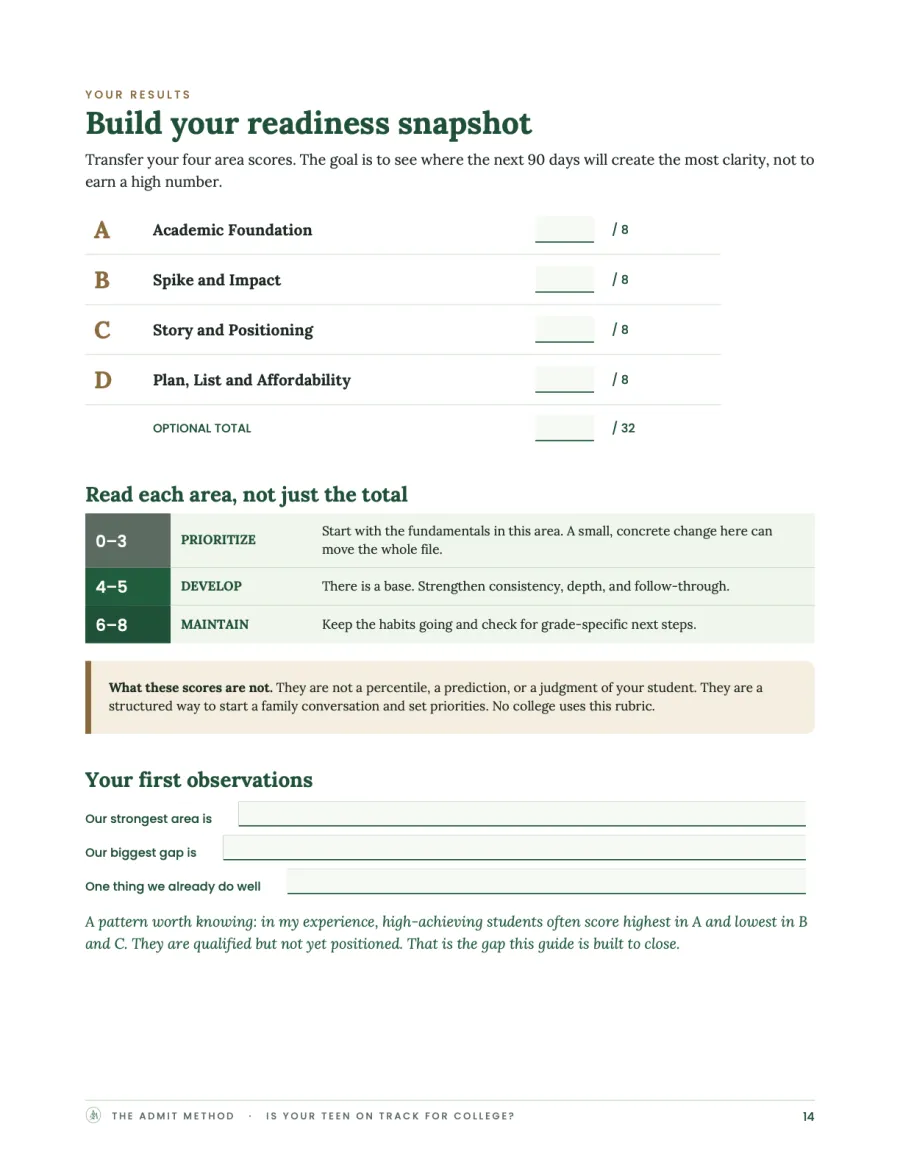
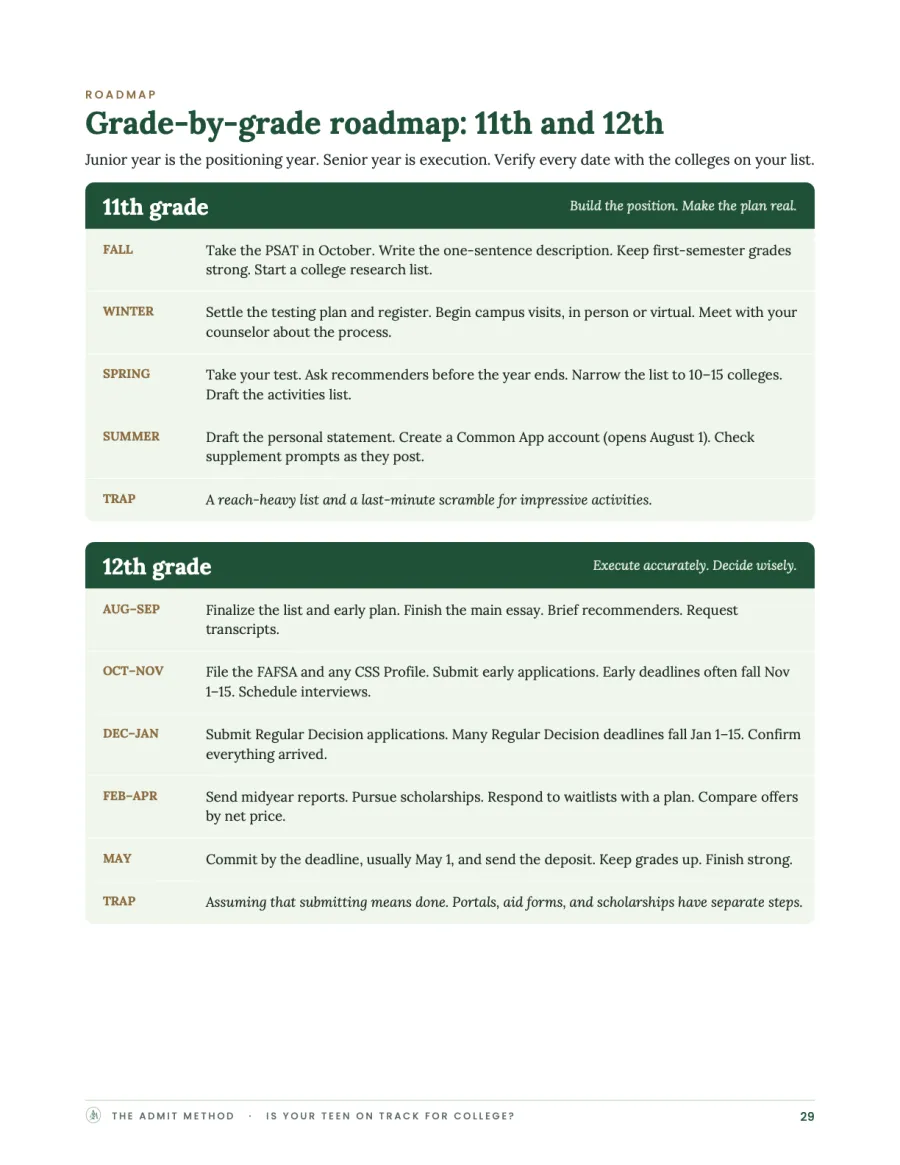
The readiness snapshot page of the guide The 90-day action plan page of the guide The grade-by-grade roadmap page of the guide
  • College Admissions Insider Guide. How selective colleges evaluate applicants, what a spike is, and why specific students get remembered. You stop guessing what admissions readers look for.
  • The 16-Question Admissions Checkup. Score academics, activities, story and planning for your teen's grade. You see the real gaps instead of worrying about all of them.
  • Your Readiness Snapshot. Your teen's strengths, gaps and three highest priorities on one page. You know what to fix first and what to leave alone.
  • The 90-Day Action Plan. An action library with a first step for every checkup question, a 12-week progress tracker and a 20-minute parent and teen check-in. The plan keeps moving without nagging.
  • Grade-specific roadmaps for grades 9-12, plus a deadline-first checklist for seniors. You know what matters this year.
  • Worksheets and templates. Activity log, recommender request, counselor meeting request, recommender brief, letter of continued interest and a college-fit comparison. Copy, fill in and send.

Bonus

A bonus one-on-one strategy call

Your purchase comes with a bonus: a private one-on-one strategy call with The Admit Method. We look at where your teen blends in with other applicants, what is missing on paper, and what to work on next. You leave the call with clear next steps for your teen.

$29 one-time

Get the guide for $29

Pay once. Download right away. Book your bonus call after checkout.

Who wrote this guide

Meet Reem

Reem, founder of The Admit Method

When Reem was in high school, she was waitlisted and then rejected by Harvard. She went on to graduate from Dartmouth, worked in marketing at Google, and was later admitted to Harvard for graduate school.

Being rejected by Harvard pushed Reem to learn how admissions works and why some students get in and others do not. She spent years learning and training in admissions.

At Google, her job was to take a complicated product and make it stand out in a crowded market. That is where it clicked for her: an admissions application is a positioning problem.

She wrote this guide so you can skip the years of digging. You need to know where your teen stands, what to fix first, and what to leave alone.

Reem, Founder, The Admit Method

Find out where your teen stands tonight.

Give it one evening: about 15 minutes of reading and about 25 minutes for the checkup. You finish knowing where your teen stands, the three things to work on first, and what the next 90 days look like.

Reem has helped dozens of students get into top schools including Harvard, Yale, Stanford, Brown, and Johns Hopkins.

  • The 37-page guide, fillable or print-ready
  • The 16-Question Admissions Checkup
  • Your 90-Day Action Plan and templates
  • A bonus one-on-one strategy call
Get the guide for $29

One payment of $29. Instant access. No subscription.

Secure checkout · $29 one-time

Checkout not loading? Open the secure checkout page.

Questions parents ask

What if my teen feels average?

Positioning works for students with big honors and for students without them. It turns real strengths into a clear story.

What if we are starting late?

Seniors start with the deadline-first checklist, then use the checkup to pick what to fix before applications go in. In grades 9 to 11 there is more room, and the roadmap for your teen's grade shows what matters this year.

What if we do not have time?

Part One takes about 15 minutes to read and the checkup takes about 25 minutes. After that, the plan asks for a short check-in twice a month.

Is this for my teen's grade?

Yes, for grades 9-12. The checkup is scored for your teen's grade, and there is a separate roadmap for 9th, 10th, 11th and 12th.

How do I get the guide?

You can download the guide right after checkout. It is a fillable PDF you can type into on screen, or print.

Can I find this for free online?

The information is out there. Sorting through it and working out what is accurate and relevant to your teen can take hours. Reem has already sorted through it for you. The checkup scores your teen on 16 specific points and turns the lowest scores into three priorities.

What if my teen does not want to do this with me?

You can read Part One and do a first pass of the checkup on your own. The guide also has a 20-minute parent and teen check-in with questions to ask, and your teen speaks first.

Is this for families aiming at the Ivy League?

The examples come from highly selective colleges. The planning parts, such as testing, the college list, cost and deadlines, apply wherever your teen applies.

Does the score predict admission?

No. The checkup is a planning tool for your family. No college uses this rubric, and the score says nothing about what a college will decide. The useful part is the action plan.

What happens on the strategy call?

It is a private one-on-one call about your teen, included as a bonus with the guide. We look at where your teen blends in with other applicants, what is missing on paper, and a high-level roadmap. You book it after checkout.